23rd February 2023
Awake at 2 am on the 12th of March, I packed my suitcase and rucksack into Sue’s Mini and set off for Stansted Airport, collecting Jim Hankers and Jeremy Brown in Market Harborough by 3 am. Paul Bissell was driving Jim Crawford and Sean Perry in his car, and we planned to meet in the airport car park around 4:30 am. With the A14 and M11 almost deserted, I set the cruise control to 70mph for most of the journey, and we all arrived within five minutes of one another.
Passport control and security were straightforward, and before long, we were enjoying breakfast in Wetherspoons, waiting for the gate number for our Ryanair flight to Marrakech to be displayed. A bus took us out to the aircraft, which departed on time. Having picked up a ‘Meal Deal’ from WHSmith, we enjoyed a cheap lunch during the three-and-a-half-hour flight.
It was a bright, sunny afternoon and pleasantly warm when we landed. Although the queue for immigration was long, we eventually made it through to the arrivals hall, where, beyond the exit, we quickly located our transfer to the Sol Oasis hotel among the throng of eager drivers jostling to display name boards in the hope of a swift pick-up.
My fellow travellers were somewhat alarmed by the chaotic city traffic and the erratic driving style. There were frequent winces and nervous comments as we narrowly avoided other vehicles, accompanied by the constant blare of horns as we weaved between carts, mopeds, buses, and cars. Particular excitement (or panic) arose when we lightly nudged a horse pulling a heavily laden wagon. Defensive driving, it seems, has no place here, not if you intend to get anywhere quickly, and everyone most certainly does.
Although the hotel transfer had been prepaid, I tipped the driver a few leftover dollars from my recent trip to the US, in recognition of his skill in keeping us alive. I later learned that one of our group had fallen victim to a classic tourist scam. Jeremy, approached by our driver who claimed he couldn’t change the dollars I’d given, naïvely offered him an additional five euros. Only afterwards did he begin to suspect something was amiss when the driver pocketed both currencies. I’ll need to keep a very close eye on my companions on this trip, I thought.

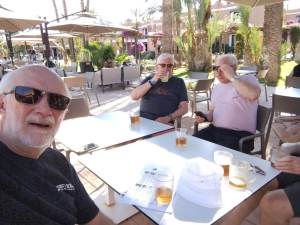
At check-in, our rooms weren’t ready, so after welcome drinks, we were invited into the restaurant for lunch. My first impression was that this ‘all-inclusive’ hotel was going to be very acceptable, and indeed, it proved to be just that.
With our stomachs full and a few beverages consumed, we collected our room keys and made our way to our accommodation, only to find that the requested twin beds had been replaced by doubles. Fortunately, this was resolved later that evening.
Though tired and not at all hungry, the six of us dutifully made our way to dinner at 7:30 pm. We washed down some very tasty Moroccan fare with copious glasses of local red wine before settling into some comfortable seating on the large poolside patio. There, we endured a single, excruciating game of Bingo that dragged on for an hour, more a showcase of the compère’s Gallic sense of humour than the brisk number-calling we had expected. By 11 pm, we had gratefully retired to bed.
Jim Hankers and I were at breakfast by 7:30 am, with the rest of our group trickling in, bleary-eyed, between 8 and 9 am. Deciding to visit the Medina in Marrakech, we were disappointed to learn that the hotel’s complimentary hourly shuttle bus was fully booked until the afternoon. Undeterred, we contacted our transfer driver from the previous day and were on our way into the city by 10 am.
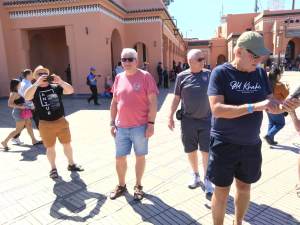

The Medina, founded between 1070 and 1072 by the Almoravids, is today a UNESCO World Heritage Site. As we neared our destination, we were halted by a group of locals who appeared to be arguing over a moped. There was plenty of jostling, and a few punches were thrown before our driver, with much honking and persistence, finally managed to squeeze past. Welcome to Marrakech, I thought.
We disembarked next to a large plaza, fronting the Kasbah and surrounded by restaurants and tourist shops. All around us were the vivid sights and sounds of the Arab world: crowds of locals in traditional, modest caftans mingled with tourists in shorts and T-shirts; the blare of car horns competed with the wail of snake charmers’ pipes and the constant cries of stallholders. It was a sensory onslaught, chaotic, colourful, and entirely captivating.
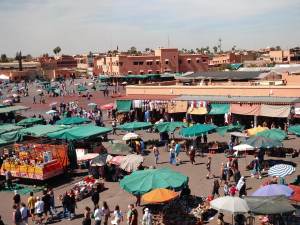

A long line of horse-drawn carriages stood waiting for those brave enough to venture into the chaos of Marrakech traffic. After a brief foray along the shopfronts to admire the trinkets on display and to experience the persistent petitioning of their proprietors, we decided to escape the melee and the midday heat. Climbing to the shaded terrace of a restaurant high above the Medina, we ordered some much-needed refreshments. Presented with a menu, we added the first of many tagines to our cooling drinks and watched the throng below from the relative tranquillity of our vantage point.
Suitably revived, we plunged back into the Medina and entered the Kasbah through its ancient gateway. At once, we were transported to another world, a scene reminiscent of the time of Saladin, straight from the pages of The Arabian Nights. Narrow, dimly lit, and utterly bewildering, the passageways wound their way through a dense warren of stalls piled high with trinkets and essentials. Navigating the visual and sensory onslaught was a challenge in itself, and trying to remain together as a group of six proved no easy task.
We shuffled through the cobbled alleyways, resisting the cries of shopkeepers who sprang into action the moment we so much as glanced at their wares. Souvenirs were bartered for and bought; I lent a hand to those unfamiliar with the art of negotiation to help them secure something close to a fair price. As we emerged from the Kasbah, I could tell that a few had ‘gone it alone’. I chose not to ask what they’d paid.


Making our way back across the plaza, we risked life and limb crossing the busy road to visit the Koutoubia Mosque. Thankfully, the group had heeded my advice: don’t attempt to judge the traffic yourself, simply watch the locals and stick close to them. Founded in 1147, the mosque is the largest in Marrakech and remains the tallest building in the Medina and surrounding area to this day. We didn’t venture inside, contenting ourselves with a peek through its large, ancient doors, where we caught sight of a few locals at prayer. After reading the information boards and indulging in some ice cream, we made our way back to our taxi pick-up point. The earlier fracas had dispersed, whether honour had been satisfied or the police had intervened, we’ll never know.
The rest of the day and evening were spent enjoying the many pleasures of the hotel’s ‘All-Inclusive’ offering. That night’s entertainment featured a band singing in French, presumably performing modern Moroccan music, as the tunes sounded anything but traditional. We all turned in early at 9 pm, as five of us were setting off the following morning for a three-day trip to the Sahara. We were leaving behind my roommate, Jim Hankers, whose recent knee operations ruled out participation in the camel ride.
I left Jim sleeping soundly and was first down to breakfast, in need of a strong coffee. Under a clear, starlit sky, we met our minibus at the front of the hotel and once again journeyed into Marrakech. There, at a petrol station, we transferred to a larger minibus, and gradually filled up with passengers of various nationalities, a lively mix of English, Italian, French, Colombian, New Zealander, and briefly, German.
Unfortunately, just as we were preparing to leave the city, the German couple had to disembark. The woman looked very unwell, lying on the pavement, tightly wrapped in a coat, while her boyfriend attempted to shield her further with more clothing. It appeared she was suffering from food poisoning. We left them behind, offering our best wishes and quietly wondering what lay ahead for them.
 It would take a day and a half to reach our destination, Merzouga Dunes. Traversing through the High Atlas Mountains past one Berber village after another, we stopped briefly at a viewpoint to take in the breathtaking scenery and to photograph a cavalcade of Ferraris that had been passing us over the last hour. Moving on, we hair-pinned through the mountains until Ait Ben Haddou, a UNESCO World Heritage Site of Ait Ben Haddou, famous for its Kasbah and fortified village and was previously used as a backdrop for famous Hollywood epics and also as a backdrop to many fashion magazine photo shoots. More recently, it has been the location of Game of Thrones and is presently being prepared for another episode.
Our little group began the visit with a wander through the village, accompanied by a guide who met us at the stop-off point. Making our way through twisting sunburnt alleys, we made our way down to the river, where we crossed with the aid of a group of small children who held our hands as we hopped from sandbag to sandbag, placed specifically for tourists and the harvesting of a tip.
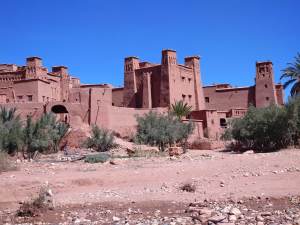
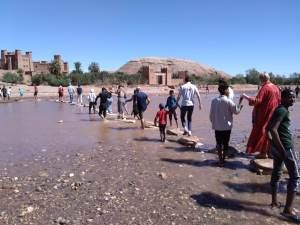
The heat of the day was beginning to take its toll as we climbed towards the fortifications of Ait Ben Haddou. Upon entering the Kasbah, we found some welcome relief in the shade cast by its tightly packed buildings. Our guide led us into a small art workshop, where we sat, fascinated, watching one of the artists dip his brush into a pot of sugary mint tea and seemingly paint nothing at all onto a sheet of paper. Once satisfied with his invisible masterpiece, he lit the burner of a small gas stove and gently held the paper above the flame. Magically, the image appeared, revealed by the heat. Intrigued and admittedly charmed, I couldn’t resist buying one.

Re-entering the furnace of the day, we continued our climb to the top of the fortress to capture photographs of the sweeping panorama. It was immediately clear why this location has been chosen for so many film productions; the views were nothing short of cinematic:
- Sodom and Gomorrah (1963)
- The Man Who Would Be King (1975)
- The Message (1976)
- Jesus of Nazareth (1977)
- Time Bandits (1981)
- Marco Polo (1982)
- The Jewel of the Nile (1985)
- The Living Daylights (1987)
- The Last Temptation of Christ (1988)
- The Sheltering Sky (1990)
- Kundun (1997)
- The Mummy (1999)
- Gladiator (2000)
- Alexander (2004)
- Kingdom of Heaven (2005)
- Babel (2006)
- Prince of Persia (2010)
- Game of Thrones – parts of the TV series

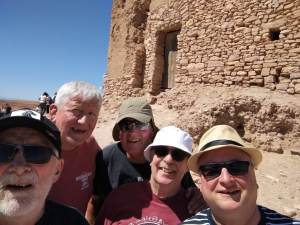
We followed our guide back to the transport, this time crossing the bridge built especially for the film Gladiator, and were grateful for the welcome relief of the minibus’s air conditioning. Leaving this iconic Berber settlement behind, we continued our journey, stopping briefly for drinks and the chance to purchase a shemagh, a traditional square cotton scarf worn by Arabs to protect against the sun and sand, and an essential item for our forthcoming camel trek. I had already bought one from Amazon the previous week and was confident it would serve its purpose. Most of the group opted for the larger, bright blue versions on offer before we pressed on to a roadside restaurant, popular with tourist coaches, for a tagine lunch.
We continued through Ouarzazate, often referred to as ‘the Gateway to the Sahara’, where we paused briefly for a rest and some ice creams, before heading onward to Boumalne Dades. This town sits at the edge of a desert plateau, at the outlet of the upper Dadès Valley. One final stop was made to admire the breathtaking scenery from a viewpoint high above the city.
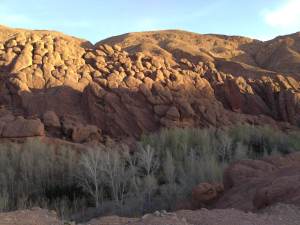

The day was drawing to a close as we entered the Dades Valley, the road winding alongside the river that had carved a deep channel through the plateau. We passed the striking rock formations known as the Monkey’s Fingers, sometimes referred to as the Cliffs of Tamlalt. These dramatic, vertical ridges resemble outstretched digits, formed from a conglomerate of boulders resting in a uniquely sculpted formation within the gorge. True to their name, they give the uncanny impression of a giant hand reaching up from the river below. Nestled nearby, within this remarkable landscape, was our hotel for the night.
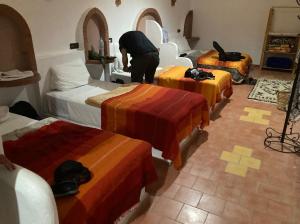
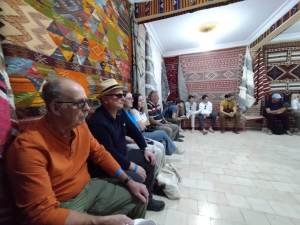 Our small group of five, along with an Italian couple, were dropped off at the first hotel; the rest of the group was staying elsewhere. The accommodation was basic but comfortable, with our room set up as a dormitory of six beds, giving us plenty of space to spread out. After checking in and dropping off our rucksacks, we made our way to the restaurant for the set evening meal: soup, chicken tagine, and fresh fruit. It was adequate and filling, though a little disappointing, particularly as it was Sean’s birthday and, being in a Muslim country, we were unable to mark the occasion with a bottle of wine.
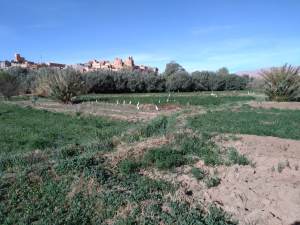
It was an early start with a 5 a.m. wake-up, followed by breakfast at 5.30 and a 6 a.m. departure for the next leg of our journey to Merzouga. We made a stop at a small, picturesque Berber village to collect another guide, who led us on a stroll through the surrounding farmland, explaining the various crops growing in the fields. Afterwards, he took us into the village where we enjoyed mint tea and watched a demonstration of traditional carpet weaving. There was an opportunity to purchase carpets, but no one took it.
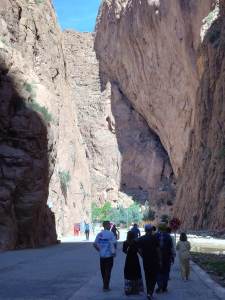
After moving on and having lunch at a local café, we entered the spectacular Todgha Gorges, a series of limestone river canyons, or wadis, in the eastern High Atlas Mountains near the town of Tinerhir. We strolled along the river flowing through the gorge, observing rock climbers clinging to the sheer cliffs above. Far too hot for climbing, I thought. We walked about half a mile along the riverbank before being picked up by our minibus. I would have loved to explore this remarkable feature of Morocco further, but time was not on our side.
We had just one more rest stop before reaching Merzouga. The village is famed for its proximity to Erg Chebbi and is a popular tourist destination. It has been described as “a desert theme park,” with Erg Chebbi called “a wonderland of sand.” Merzouga also boasts the largest natural underground body of water in Morocco. The Saharan dunes, rising like orange waves topped with creeping black shadows, were visible on our left for well over an hour before we arrived. Having seen many photos of these dunes, I had assumed their colour was enhanced, but it is not; they truly are one of nature’s wonders.


As we arrived on the outskirts of the village, we could see strings of camels resting among the scrubland, patiently waiting for the hordes of tourists about to descend upon them. Their drivers, dressed in robes and shemaghs, sat cross-legged beside them, chatting and no doubt sizing up the arriving tourists spilling out of their vehicles. Five members of our group were selected, while the rest of us watched from inside the minibus as they frantically shouldered their rucksacks and attempted to remember how to wrap their blue scarves purchased the previous day.
We saw the first two called forward to mount their steeds and flinched as they grimly clung on during the camel’s initial movements. First, the protesting animal threw them violently forward, then backwards, and lastly forward again. The rest of the camels began to grunt and complain loudly at what was to come.


Our minibus drove out of the scrub and into the dunes, continuing for around a quarter of a mile until it came to a halt between two towering dunes. As we stepped down, shouldered our rucksacks, and wound our shemaghs into place, the minibus departed, leaving us alone.
Where were the camels? There had been plenty of strings of riderless beasts when we first stopped, so why hadn’t we mounted them yet? Were we being kidnapped? Our group of eight confused and camel-less wannabe Bedouins wandered nervously between the dunes, wondering what on earth was going on.
About ten minutes later, the plaintive grumbles of camels echoed across the sand, and slowly, from behind one of the dunes, the first of a caravan of eight animals and two drivers appeared. So, it seemed, we were not to be ISIS hostages after all!
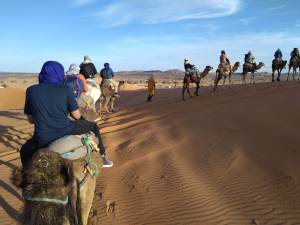

The drivers assigned each of us a camel according to our size and weight. Mine bellowed and grunted loudly as I settled astride, then halfway to standing, decided to plop back down and complain noisily. I was beckoned to dismount while the two Arabs adjusted the cushioned saddle, then gestured for me to remount. This time, Annabel, as I’d taken to calling her, stood patiently in line as the rest of our party mounted and lurched upright, some, like Annabel, grumbling vociferously.
We set off, led by one of the drivers who walked ahead of the lead camel, gently tugging on a rope attached to its mouth. Each camel was tethered to the one in front by the same method. It was a most uncomfortable ride; with legs akimbo, we gripped a metal T-bar to steady ourselves and avoid falling off. The first 15 minutes of rhythmic lurching were tough, as bones, sinews, and muscles voiced their protest at this unfamiliar position. Eventually, I found my camel legs, settled into a tolerable posture, and began to enjoy the experience.

Annabel

It was hot, it was dry, and it was perfect! Just as I had imagined, the caravans of old made their way across the desert for centuries, following a string of reliable wells and oases while circumventing mountain ranges or sand seas. Slipping into the role of Lawrence of Arabia, perched atop my beast of burden, I found myself romanticising the life of a Bedouin tribesman, well, at least for the hour and a half it took to reach our camp for the night.
As we progressed over the dunes, following a well-worn trail scattered with small pellets of camel poo, we could see dung beetles scurrying among the little packets of food, leaving a trail of footprints in their wake. One was trampled by the camel in front, but as soon as the foot was lifted, it shook itself free of the sand and scurried away. They are tough little beggars!
Each time we reached the crest of a dune, distant caravans could be seen slowly marching their burdens towards some hidden encampment. Several times, we stopped when a driver noticed a saddle had slipped on one of the camels. After setting the animal down and the rider dismounting, the two Arabs would set about adjusting the saddle before we set off again.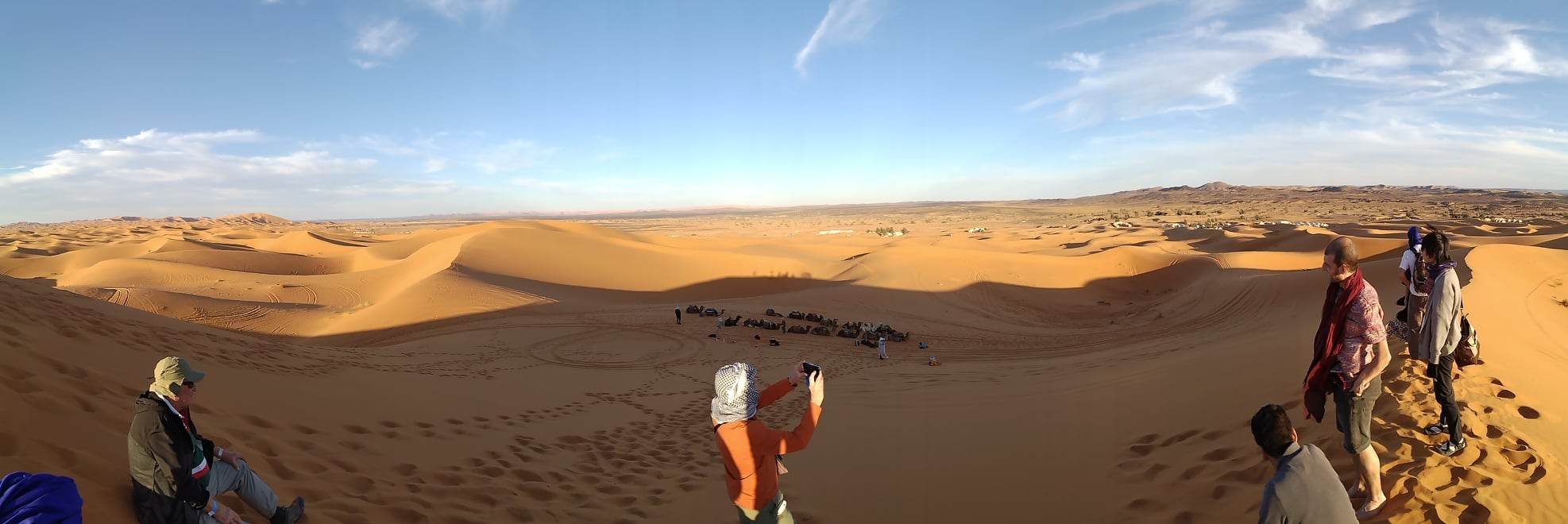
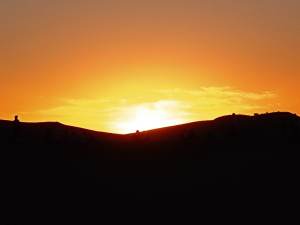

As the sun began to set behind us, the shadows deepened into vivid contrast with the shifting orange dunes, a truly extraordinary and inspiring sight, one that left a lasting impression, needing no photograph to conjure the memory.
As the sun dipped closer to the horizon, we could make out the tents of our encampment a short distance away. With great difficulty and fresh aches, we dismounted the camels and, encouraged by our drivers, climbed to the top of the final great dune of this trek to capture photos of the setting sun over the stark desert landscape. Exhausted by the effort, the five of us lay in the sand, the wind blowing fine grains of silica into every nook and cranny, waiting for the colours of the sunset to spread across the heavens to take our shots.
As the sun disappeared beneath the horizon, under a growing starlit sky, we made our way down the dune, retrieved our rucksacks, and boarded a 4×4 for the final leg into camp. I suppose camels aren’t keen on carrying tourists in the dark.

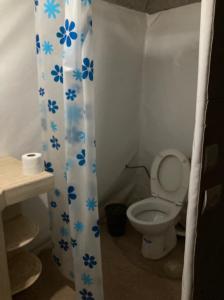
The five of us were allocated a tent with six very hard, low-lying beds covered in rugs, each topped with a brick-like cushion. There were no sheets or pillows; this was to be Bedouin style. In one corner stood a toilet, its privacy guarded only by a thin curtain, and nearby a shower head hung, though none of us were brave enough to test whether it actually worked.
Over the next hour, the rest of the camp slowly filled as another caravan, primarily French, arrived. At 7 pm, we made our way to the food tent and sat in the semi-darkness, joined by our new campmates. After half an hour, just as we began to suspect our Arab hosts had deserted us, the whirr of a generator heralded the arrival of light, and with it, our dinner of soup, chicken tagine, and fruit.
We had been warned that tomorrow would bring another 5 am wake-up, breakfast at 5.30, and a 5.45 am camel trek back to the minibus. An early night was essential, or so we thought. After marvelling at the spangled desert sky with the rest of the camp, it was 10.30 pm when we finally lay on our instruments of torture, the beds, inside our tent. It was then that our Bedouin hosts brought out the bongo drums around the campfire to entertain those who hadn’t succumbed to fatigue. The last slap of the bongo didn’t sound until 2 am!
Paul decided to rise at 4 am, closely followed by a frozen me. I expected the temperature to drop during the night, but I hadn’t anticipated it would plummet so far! By 4.30 am, we were all awake, dressed in our tents, and ready for breakfast.
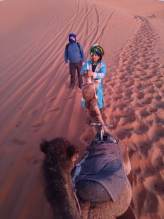
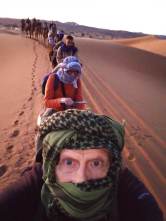
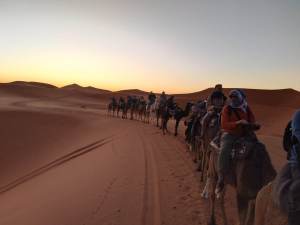
Not everyone in the camp ate that morning; I hoped those who had kept us awake were the ones to starve. By 5.30 am, we were all standing outside the encampment, once again gazing in awe at the cosmos. After some twenty minutes, the grunting of reluctant camels echoed in the distance, but this time there was no complaining as we mounted and set off back into the dunes.
We took a different route on our return to the waiting transport. The first half hour of our trek was in darkness; it wasn’t until the sun finally peeped over the horizon behind us that we could see we were still in the Sahara and not on the moon. I found this leg of the journey less painful than the previous one. I suppose a night on a Bedouin bed is perfect bone-stretching preparation for an hour or two on a camel.
For the latter part of the trek, I found myself on the lead camel, as for some reason the animal in front was relegated to the rear of the caravan. Not having the camel’s rump to focus on for steadying my seat took some getting used to, but like Lawrence, I soon slipped comfortably into the role of leader.
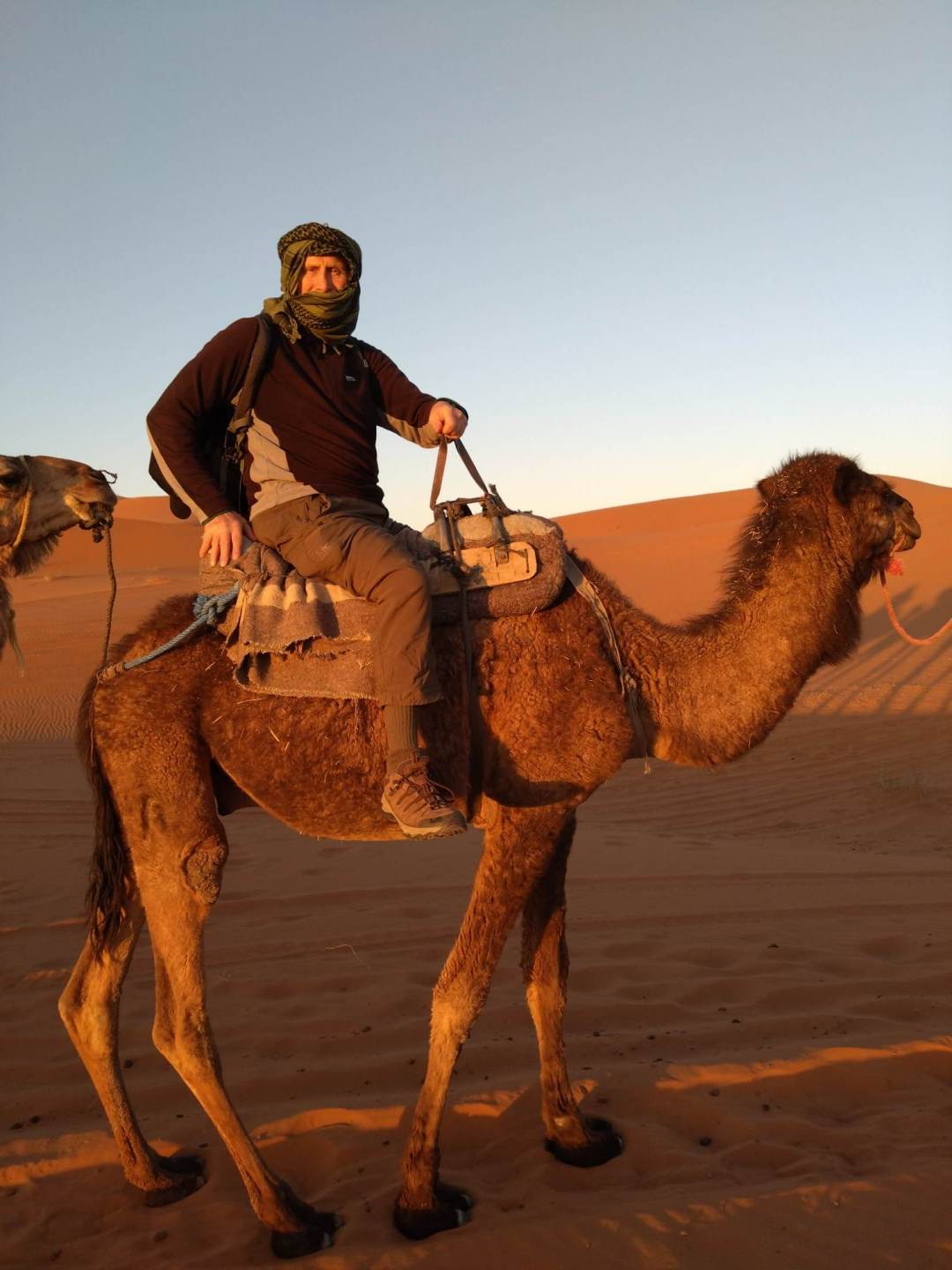
Arriving back at our transport, we tipped our drivers before setting off to pick up the rest of the group. As we said our goodbyes to the Sahara, the first part of the journey was filled with swapping stories and comparing experiences. It turned out the other group had camped somewhere with proper beds, warm and comfy all night long. We consoled ourselves with the thought that we had gone for the full Bedouin experience, and it was they who had missed out. Though I must admit, a pillow would have been a welcome luxury!

The journey to Marrakech was long and tiring, retracing the same route we had taken before. We all sat in the same seats throughout the three days, so when we weren’t dozing, we passed the time watching the changing landscapes through the window. Every hour or so, we stopped for refreshments and a quick break. Lunch was a leisurely affair at a pleasant restaurant on the edge of a town, overlooking lush fields of alfalfa. We were the first to arrive and were served promptly. Shortly after, several other tour buses pulled up, disgorging their passengers into this well-oiled system designed to feed hordes of tourists eager to experience the Sahara, or returning from it. Whether they were heading into the sands or coming out, I didn’t judge; I just marvelled at the speed of service. Even McDonald’s could learn a thing or two here.
The five of us were the first to be dropped off in Marrakech, around 8 pm, where a smaller minibus was waiting to take us on to the Sol Oasis. When I got back to the room, Jim had just returned from his evening meal and was watching TV. Seeking company, he joined me in the restaurant, where the six of us soon found ourselves enjoying copious glasses of wine and a substantial meal that, for once, didn’t include a tagine. We ended the evening listening to music in comfortable seats with soft cushions that didn’t sway or lurch once. We had survived the ‘ships of the desert,’ and this was our well-earned reward.


We all made breakfast at different times, but by 10 a.m., we had agreed that the planned ‘free’ tour of Marrakech wasn’t going to happen. We needed to chill out and enjoy the facilities of this rather nice hotel.
That evening, we attended a ‘Fantasia’, a vibrant showcase of Moroccan culture featuring dancers, acrobats, riders, fireworks, and folk music, held on the outskirts of Marrakech at the exotic Chez Ali restaurant. We were picked up by minibus at 8:15 p.m. from the hotel and, along with three French women, had a short drive to reach our destination.
As we disembarked, the theatre came alive. Passing between two lines of prancing Arab horsemen, we made our way to the entrance, only to be further impressed as we descended into an underground grotto. This dimly lit, artificial tunnel twisted and turned until it eventually ejected us into a cacophony of noise and light. Costumed dancers swayed and screamed around us as we moved through a set of gates, pausing only to have our photo taken with a couple of beautifully attired Berber women before seemingly bursting into a huge arena surrounded by towering castle walls and Berber tents.
It was an assault on the senses, magnificent, spectacular, and utterly overwhelming!


We made our way past more dancers, fire eaters, and pipe players to one of the tents at the far end of the arena, where we were shown to our table set for six. Over the next hour, a feast arrived alongside a steady stream of singers and dancers performing inside the tent. By 10 p.m., we had eaten and drunk until we could do no more, then left our tent to take seats at the edge of the arena to watch the main show.
It began with twelve horsemen charging down the length of the arena, firing their rifles into the air as they raced level with us. My heart nearly stopped at the blast wave from their muskets. How on earth do their steeds get used to this? Next came belly dancers, fire eaters, camels, and sheep. Several more galloping charges followed, each punctuated by the thunderous discharge of firearms and accompanied by the wailing of pipes and the beating of drums.
The show lasted an hour and featured a cast of hundreds. By midnight, we were back at the Sol Oasis, well satisfied with our brief but immersive taste of ‘going native.’

We spent the next couple of days at the hotel, recharging our European batteries by playing pétanque and pool, swimming, sunbathing, and sampling as many delicacies as we could at mealtimes. Sangria and gin and tonics became the favoured afternoon drinks, while red wine and beer were reserved for the evenings. On Saturday night, we enjoyed some mild excitement as we joined a few other Brits in the theatre to watch Scotland beat Italy and Ireland defeat England in the Six Nations Tournament on a large screen.
We were fortunate on our last evening when, while relaxing by the pool during one of the children’s activities, an announcement informed us that the clocks would be going back one hour that night. This was a crucial reminder, as it would have surely impacted our early morning transfer to the airport. We adjusted our watches accordingly.
Our stay at the Sol Oasis concluded with a memorable show in the hotel theatre, a brilliant mix of dance, music, and pyrotechnics performed by the animation team. It was the perfect way to end what had been a fantastic week.
We had breakfast at 7 a.m., boarded our taxi at 7:20 am, and arrived at the airport by 8 a.m., enjoying a smooth transfer with no undue hassle. The previous night, I had checked us all in online via the Ryanair app, only to discover that I then had to visit their website to access the boarding passes, a rather annoying two-step process! I sent the boarding cards via WhatsApp to the rest of our group. However, at security, we were told the passes needed to be validated at a check-in desk. This required a trek across the terminal and queuing to obtain handwritten paper boarding cards. I can’t fathom why a single staff member had to handwrite hundreds of boarding passes, copying the same details from passengers’ phones. Nevertheless, the rest of the process went smoothly, and we were soon on our way to departure.
As we made our way through the airport, it was clear that many passengers were in a blind panic, begging their way through queues with the excuse that their flights were about to leave. I suspect this was the inevitable consequence of not realising the clocks had gone back.
Our flight departed 20 minutes late and, due to a headwind, we landed at Stansted 40 minutes behind schedule. There were no queues at immigration or security, so we were soon outside heading to the Blue Short Stay Car Park. It was a quiet Sunday on the roads, and by around 4 p.m., we were back in Harborough.
Job done!


Leave a Reply